Tuesday, 15 May 2018

Seven Steps to Get a Business Loan for Your Restaurant

Building a restaurant business requires capital, and one way to obtain that capital is through a business loan. But qualifying for a business loan can be hard if you don’t meet business lenders’ strict standards.

As a result, the more you know about what lenders require and what you need to be eligible, the easier it will be to get approved for your establishment or to the find the next best thing.

Here’s what you need to do to get funding for your business with a business loan.

Determine How Much Money You Need and Why

Lenders will likely ask you this question, and it’s also good for you to know, so you can justify taking out the debt.

Depending on how established your business is, your reason for taking out a business loan could fall into one of five categories:

  1. To get started
  2. To manage day-to-day expenses
  3. To have a safety net
  4. To invest in new equipment or inventory
  5. To start building a business credit history

Now is also a good time to decide how much you need. Avoid guesstimating because you could end up with more debt than is necessary, or less money than you need. Instead, take the time to calculate the loan amount based on detailed cost projections, and how much you can afford in monthly payments and interest.

If you’re not sure how to do this, consider hiring an accountant who can help you and other accounting needs.

Decide Which Type of Loan Is Best

It may be difficult to get a business loan if you’re just starting out. Many small business lenders require you be in business for a certain amount of time and have a minimum annual revenue.

If you have no revenue and no established business, you might also consider applying for a personal loan or a small business credit card.

Personal loans and business credit cards are unsecured, so they don’t require that you put up collateral like a business loan. That said, they typically charge higher interest rates than business loans. Also, personal loans don’t help build a credit history for your business.

If your business is established, you’ll have several other options to fund your business, including:

  • Small Business Association (SBA) loans
  • Bank loans
  • Business lines of credit
  • Invoice factoring
  • Microloans
  • Merchant cash advance

Each of these options varies in eligibility requirements, terms, and costs. Research each option thoroughly to determine which is best for you and your business.

Check Your Credit

If your business is established and you’ve borrowed money in the business’ name before, you may have a business credit score. Check your business credit report to get an idea of where it stands and what you can potentially do to improve it.

The Experian Intelliscore Plus business credit score ranges from 1 to 100 and predicts seriously derogatory payments.

Intelliscore PlusSM Score Range

Risk Level

1-10

High Risk

11-25

High Risk

26-50

Medium Risk

51-75

Low to Medium Risk

76-100

Low Risk

If you don’t have a business credit score or your score is fairly low, you may need to rely on your personal credit history to get approved for a loan.

You’ll have a better chance of getting approved for a loan if your personal credit score is considered good or better, so check your personal credit score to see where it falls. Here are the ranges for the FICO® 8 Score:

Credit Score

Rating

percent of People

Impact

300-579

Very Poor

17 percent

Credit applicants may be required to pay a fee or deposit, and applicants with this rating may not be approved for credit at all.

580-669

Fair

20.2 percent

Applicants with scores in this range are considered to be subprime borrowers.

670-739

Good

21.5 percent

Only 8 percent of applicants in this score range are likely to become seriously delinquent in the future.

740-799

Very Good

18.2 percent

Applicants with scores here are likely to receive better than average rates from lenders.

800-850

Exceptional

19.9 percent

Applicants with scores in this range are at the top of the list for the best rates from lenders.

If your credit isn’t where it needs to be, consider taking some time to improve your credit score before applying for a business loan.

Compile Financials and Gather Documents

Business lenders need to know if your business is a good risk before giving you money. While a business credit score can help with that, it’s not the only thing lenders check.

For example, you’ll also need to put together your financial statements, including your balance sheet, income statement, and cash flow statement for the past year or two. You may also want to put together a business plan and include these financial statements with forecasts for the next three-to-five years.

Other statements and documents you may need when applying for a business loan may include your:

  • Business and personal bank statements
  • Business or personal credit report
  • State registrations and licenses
  • Articles of incorporation or other required legal documents
  • Business and personal tax returns

You don’t necessarily have to have all of this information together when you apply. But it can speed up the process significantly if you’re prepared.

Determine Your Collateral

Business loans typically require collateral to protect the lender’s interests. If you have an established business, you may be able to put up some of your business assets to secure the loan, including:

  • Vehicles
  • Equipment
  • Buildings
  • Land
  • Inventory
  • Accounts receivable

If you don’t have sufficient business assets, you may have to use your personal assets as collateral, such as your vehicles or home. But remember that the bank can take these assets if your business defaults on the loan, so avoid using personal assets that you can’t afford to lose.

Shop Around for the Best Business Loans

You can get business loans from several different lenders, including traditional banks, online lenders, and nonprofit microlenders.

The best way to find the best terms for your business loan is to compare offers from several lenders. Start by determining which lenders offer the type of business loan you want, then compare at least three or four lenders in that category.

Look at the annual percentage rate (APR) they offer, as well as other terms, such as loan limits, repayment terms, fees, and penalties. The most important factors to keep in mind are the monthly payment and the total cost of the loan.

If you’re looking for a personal loan instead of a business loan, the process is a little more straightforward. Simply compare several top personal loan companies based on rates and other terms, and pick the one that works best for your budget.

Apply For and Close the Loan

Once you find the right lender and loan, go through the application process. Because each lender is different, you may be asked to provide documentation in addition to what’s described above. Get any additional documentation to the lender as soon as possible to avoid delays.

Note that it can take a while to process a business loan application, so you’ll want to apply long before you actually need the funds. For example, it can take up to two to three months to get an SBA loan, depending on the situation.

Keep in contact with the lender throughout the process to make sure it’s going smoothly. As soon as the loan closes, create a strategy to pay off the loan.

A good strategy can help you avoid the problems that come with defaulting, including losing your collateral and seeing a negative impact to your business or even personal credit score.

The Bottom Line

If you need funding for your business, a business loan is a great way to do that. But it’s important to understand how to get a business loan in a way that limits your costs and gets you the type of capital you need.

By following these steps, you’ll have a better chance of getting the type of loan you need, and at a price your business can afford.  

This article was published on the Experian Blog.


Seven Steps to Get a Business Loan for Your Restaurant posted first on happyhourspecialsyum.blogspot.com

Monday, 14 May 2018

Restaurant Data by Segment

Restaurant data is a resource every operator should be mining, no matter their segment.

Restaurant Data —what an open-ended term! If you’re a restaurant operator, you’ve likely encountered it by now. In practice, analyzing and applying restaurant data can seem a bit overwhelming. After all, restaurants, no matter their size, generate untold amounts of data every day, from the number of napkins they keep in stock to their average party size and sale. That’s a massive amount of info!

In reality, restaurant data is a resource every operator should be mining, no matter their segment. And you don’t need to be an expert with numbers or sacrifice precious time to do it. We’ve broken this article down into four primary restaurant segments to illustrate the significant “data generators” and how you can track that data. Since all restaurants are unique, remember that you can “mix and match” here and that these data points aren’t mutually exclusive to one segment. This article should serve as a useful springboard for you in your restaurant analytics efforts!

Quick Service

As the name suggests, your primary focus here is processing orders quickly and efficiently. As such, you’ll want to focus on the back-of-house operations here. Some data points to examine include: 

  • Cook times – Denotes the start and finish time of an entree; Literally, how long it to prepare.
  • Plating to Table/Counter Times – How long it takes to get the order from the kitchen back onto the floor. These are the types of data you can use to determine chokepoints and holdups in your kitchen, your literal speed of service To track this data, you’ll want an automated solution, like a kitchen display system, which can track and store this data for you. By analyzing cook times and trends, you can identify peak traffic times, as well as other bottlenecks in your workflow. Additionally, a system with “expo views” that allow you to section off into different kitchen stations will help you further identify your kitchen efficacy, at a granular level.
Fast Casual

Working in the fast-casual segment, you’re obviously still going to consider your BOH operations, but will also put more emphasis on your guest management efforts like how well you’re blending your traffic between walk-in guests, off-premise pickup and delivery, and every other dining variation the segment has to offer.

Some additional data points to consider include:

  • Average party size – At a given moment, the number of guests you’re likely to see per order. While you may not offer table service, it’s still a useful metric to consider with limited seating.
  • Average order – Here’s the average amount of money a guest spends per visit, data you can measure to determine your most profitable hours, shifts, seasons and entrees.

You’ll need technology that can integrate with your POS so that you can gain insight into your customer’s spending patterns. Remember also that with guest traffic coming from so many different areas, a KDS with capacity management features can help in streamlining this. It can “read” the existing workload in your restaurant, and use this data to create accurate pickup quotes for off-premise customers.

Casual Dining

With so much emphasis on table service in the casual dining segment, you need front and back-of-house technology to keep all your processes in order. Not only are you considering your kitchen bandwidth, but you’ve also got to account for your seating economy.  

Some additional data to measure in this segment include:

  • Wait times – Utilizing all the data at a given moment, like existing traffic and average turnaround times, how long will a party of a given size need to wait? Often, these are high-volume restaurants.
  • Turnaround times: This determines the figurative “life cycle” of a guest or party, from the time they order to the time they leave.
  • Seating efficiency: the actual measure of how well you’re utilizing the seats in your restaurant. While a seating efficiency of 100 percent isn’t likely, it’s the benchmark.

While you could calculate all of these manually, a more effective option is to use a guest management tool which can automatically calculate this data, as well as present historical averages to compare against current data. You can measure this data to determine places or times in your workflow when traffic spikes, data which can help inform your staffing efforts. Depending on your restaurant, you may also want something with waitlist and reservation capabilities. 

Fine Dining

At this segment, you’ve got to have every process in your restaurant running at optimal level. Here, you’re not dealing with so much walk-up traffic, as much as reservations and waitlisting. In this regard, capacity management features in your BOH – those that can consider average turnaround times, and provide real-time order statuses – will help pace your orders, keeping food fresh and hot for the ideal guest experience. Ideally, you want waitlist technology that can integrate with your BOH when taking in reservations to prevent you from overbooking.

Catch-All’s
  • Inventory Management – No matter your segment, you need to stay on top of the finite resources in your restaurant. While you could keep a paper-and-pencil accounting of everything you’ve got, we wouldn’t recommend it! Look for something automated, and which can alert you when something gets low, so you can stay on top of your materials.
  • Customer Data – Guests are the lifeblood of any restaurant, no matter the market. Look for ways to store customer data, like order histories or food allergies so that you can market to them more effectively. Consider creating a loyalty program to incentivize them with future visits.

Ultimately, your restaurant will create data, no matter what. Those willing to track and analyze that data, and employ an automated solution to help, will build more a more efficient, more profitable operation.


Restaurant Data by Segment posted first on happyhourspecialsyum.blogspot.com
Friday, 11 May 2018

Pilotworks: Learning to Fly

Pilotworks, a community of food incubators, mentors and entrepreneurs, recently opened a facility in Newark, New Jersey. The kitchens provide access to flexible cooking infrastructure and equipment that rents by the hour and month, lowering the barrier to entry to young culinary entrepreneurs.

They play host to market vendors, QSRs, CPG companies, bakers, caterers, delivery-only concepts, ice cream makers, chocolatiers, meal preppers and many other forms of culinary entrepreneurs. The company also connects their members with access to their network of 75-plus mentors that help with a wide range of topics, including fundraising, legal, social media strategy, recipe development, sourcing, branding and accounting. Pilotworks has spurred business growth for food businesses including Aida Eats, Mac & Son, BOONBOX, Dank and Crown Jewel Beverages.

Co-founders Mike Dee and Nick Devane acquired the first kitchen in September 2016 as a way of supporting emerging food startups. Since its launch, Pilotworks has helped 250-plus nascent food and beverage businesses start and scale. The businesses in the kitchen are more than 70 percent women and minority-owned.

In this MRM Profile, Pilotworks Newark GM Ted Rosen and Makiko Ishida, Founder of Alter Native Foods discuss the Pilotworks experience. 


Pilotworks: Learning to Fly posted first on happyhourspecialsyum.blogspot.com

Jack in the Grubhub Box and Have an Olive Day

MRM EXCLUSIVE: Five Questions to Ask When Buying a Restaurant POS System

Whether you’re buying a Point of Sale (POS) system for the first time, or looking to upgrade your existing system, the process can be be quite involved. Technology has come so far in just the past few years, that it’s easy to be overwhelmed by the options available to you and your restaurant.

Start your search with these questions for a new restaurant POS in order to choose the best possible system, without getting bogged down by decision fatigue.

Does It Play Well with Others?

Your POS system is arguably the most important tool in your entire restaurant – yes, even when compared to your kitchen appliances. However, it’s not the only tool you’ll use every day. Most restaurants also use some combination of employee tracking software, accounting services, and more. Simplify your restaurant operations with a POS system that has the capability of integrating all your solutions.

Your POS provides valuable metrics when integrated with other restaurant technologies. You’ll save the most by choosing a POS that comes with its own Guest Manager, in order to keep the integration of these systems as seamless as possible.

Will It Simplify Inventory Tracking?

One of the most important features of any POS system is the way it tracks your inventory. Controlling food waste is one of the biggest contributors to lost revenue. You should have easy access to all the information you need about your menu items, from a list of bestsellers to an itemized breakdown of your most profitable ingredients.

Choose a POS that allows you to track sales and profits by menu item and by individual ingredient, so you can make intelligent purchasing decisions every time you place an order. Some POS  systems even have the ability to notify you when you’re running low on a particular item, so you can alert guests the moment they sit down, avoiding any possible disappointment (and the negative reviews that tend to follow).

Can It Process Online Orders?

Many restaurants rely on third-party services, like GrubHub or Seamless, to handle delivery and online ordering. These services charge you as much as 15-30 percent per order, and using their services drives traffic to their websites, not yours.

By choosing a POS system that can handle online ordering directly, you save time and money, while simultaneously improving customer loyalty. Integrated Online Ordering (OLO) adds revenue to your bottom line, while adding additional revenue channels on your website and Facebook page.

Connect with your guests directly in order to learn more about them (by saving their order history in your POS), and give them even better dining experiences both in-store and at home. Best of all, you save money on every order, which makes OLO more profitable than ever.

 Is Mobile Support Offered?

The most powerful POS systems on the market provide multiple mobile options. Some of them offer a mobile app for guests to download and connect to your website, while others offer tablet-based checkout for streamlined service in-store.

Empower your servers to take every order with a tablet, and they’ll be able to send each item directly to the kitchen – saving time and money on disposable goods like paper and pens, while reducing human error.

Best of all, this new kind of checkout will impress your guests, improving their experience, and their loyalty to your restaurant.

Is Your Data in the Cloud?

Cloud-based reporting is one of the most exciting features that state-of-the-art POS systems can offer you. With cloud reporting you can track your restaurant’s daily numbers from anywhere, any time.

This means that you’re free to take days off, and even travel without worrying about what you’re missing at the restaurant. Check in on your numbers every day – or even every hour – and make updates to your inventory and your employees’ schedules in real time. Data-backed decisions help you run your restaurant better. Keep your business running smoothly from anywhere, and you’ll be more successful both in your restaurant, and in the rest of your life.


MRM EXCLUSIVE: Five Questions to Ask When Buying a Restaurant POS System posted first on happyhourspecialsyum.blogspot.com

Thursday, 10 May 2018

MRM @ the bar: Poolside Cocktails in a Can

Glass by the pool is a major safety issue so Feisser Stone, founder and creative director of full-service bar consulting company Barlingual, designed lifeguard-approved cocktails for restaurants and bars near or  a pool. He  is launching his take on classic cocktails such as Palomas, Cosmopolitans and Pina Coladas that will be served in cans as opposed to glasses at the Mosaic Hotel in Beverly Hills. The Instagram-worthy drinks feature different bases such as La Croix Pamplemousse, Red Bull and Coca-Cola.

In this MRM @ the bar, Stone crafts his pool-friendly version of a Pina Colada with Bacardi Pineapple, La Croix Coconut and lime juice.

Barlingual is a cocktail lifestyle company focusing on full bar program development and events. Clients include restaurants around greater Los Angeles, events for major corporations, and partnerships with leading chefs. Current clients include the Wallis Annenberg Center for the Performing Arts in Beverly Hills, El Nopal in Palms and Madre in Torrance. 


MRM @ the bar: Poolside Cocktails in a Can posted first on happyhourspecialsyum.blogspot.com

What’s Fresh in Menu Design?

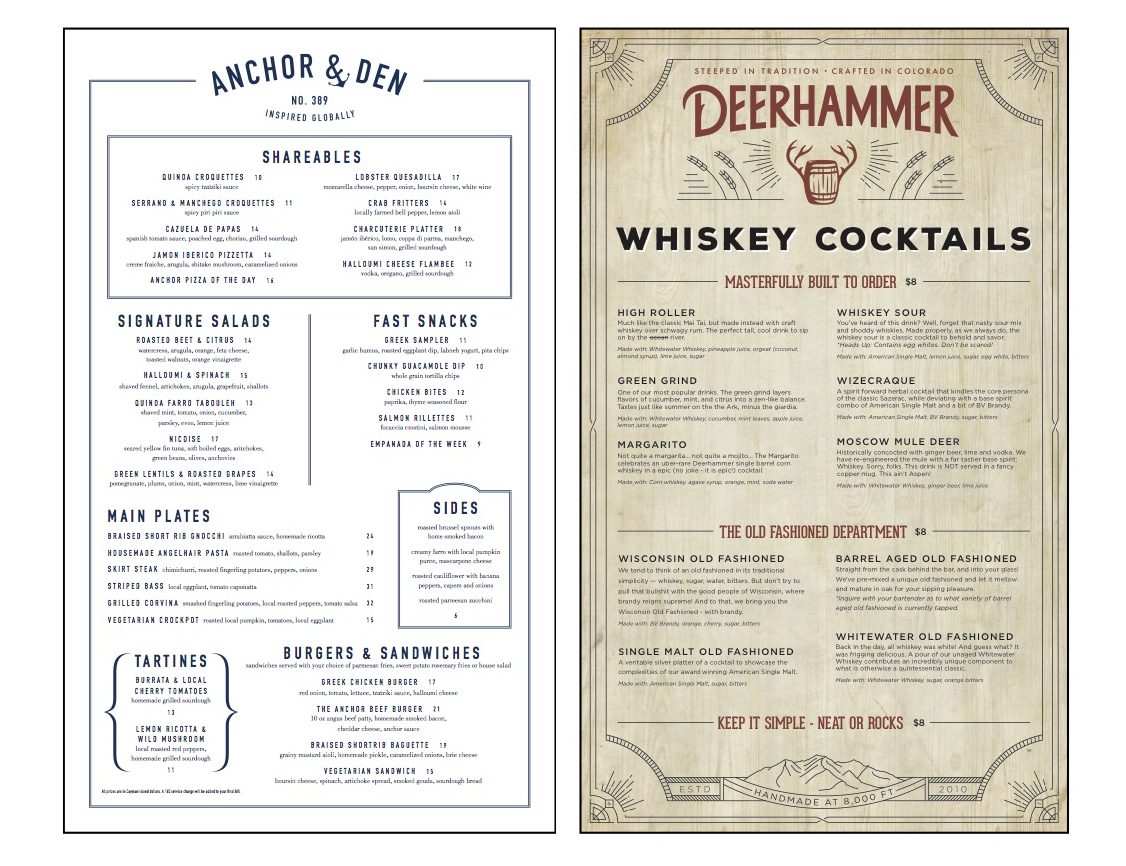
Your menu is the first thing people see when visiting your restaurant, and usually even before they arrive, they’ve checked it out online. It is arguably what potential customers base their decision on when they as their friends and family, “Where should we go eat tonight?” Once customers are seated, they want to enjoy perusing the menu, linger over tempting choices, and discuss with their fellow foodies whether they’re going to be adventurous and try something new or order an old standby they already know is their favorite.

At TerraSlate, we help restaurant and bar owners’ menus set the tone for one of the finer things life has to offer — an exceptional and satisfying meal.

Whether you’re opening a new restaurant and creating a menu from scratch or a well- established eatery simply looking to revamp or update your menu, here are some expert tips from our designers that will put your restaurant ahead of the competition before a glass of water even hits the table.

No Dollar Signs

Keeping a sleek, simple design means keeping clutter to a minimum. You don’t want your customers to have to sift through any distractions to get to the good stuff — tantalizing descriptions of dishes they’ll keep coming back for. Making everything $19.95, for example, cheapens the item and let’s be honest, you’re not fooling anyone into thinking saving them a nickel is getting them the deal of the century. If the item is $20, a simple “20” will do. No change, no decimals, no zeroes, no dollar sign. Just 20.

Avoid Price Lining

Keeping with the philosophy of drawing the least amount of attention to the final bill that’s to come, don’t line up all the prices in a column. Columns with numbers on spreadsheets are great when you’re doing cost analysis for your quarterly earnings, not so much when you want to keep prices out of the spotlight and let the dishes take center stage.

Organize Your Menu in a Logical Order

Seems to be a no-brainer, but it bears repeating that your menu order is not the place to get creative. Appetizers first, salads next, entrees and then desserts and beverages.

Put Your Best Dishes at the Top

Again, don’t be tempted to list your food items by price from least expensive to most. We know deprogramming everything you ever learned in middle school math seems illogical, but your restaurant’s signature dishes should go right at the top. Customers are drawn to the upper right hand corner of the menu first, so your entrees that will have them telling their friends about them the next day and posting photos on Instagram are the ones you want to place there.

Follow Simple Design Rules

Stay away from crazy fonts and lots of images. Newspapers and magazines have known for years that for best ease of reading, stick to a serif headline and a sans serif text, or vice versa. Fancy scripted fonts are pretty to look at, but if your customers can’t make out what it says, they’re probably going to think twice about ordering it. Stick to a 10 to 12 point font in descriptors, and just like interior or fashion design, less is more.

Use Color Sparingly

Stark white menus can seem oversimplified and uninviting. Consider picking a warm neutral for the background. We find that nudes and peaches are popular choice because they are easy on the eyes and don’t compete with the menu items and text. Pops of color are OK, but again, a little goes a long way. Burgundy titles with black descriptors will add some pleasing color to your menu without distracting from the menu item itself. Warm colors are best since cool colors like deep blues are known to suppress appetites.

Yes, Size Does Matter

Obnoxiously huge menus are unwieldy for customers to hold, and they take up precious table space. Small menus — 8.5 by 11 trifold — are fitting for venues where they never leave the table, such as beachside tiki bars or diners, and some of our customers still live by the “bigger is better” philosophy, opting for the 11 by 17 size. For them, we’re happy to accommodate, but we find the majority of our clients find somewhere in the middle is best. An 8.5 by 14 (legal size) menu is just right, whether as a front and back single sheet, or folded into a bifold or trifold menu.

Leave a Little Space for Marketing

Encourage your diners to follow your establishment on social media for specials and events. A half inch plug at the bottom of the page with your Facebook or Twitter handle means all those check-ins and “food porn” posts will get you tagged and mentioned online. Got an app? Let them know! (#yourrestaurantname)

One Menu or Two?

Customers are actually more comfortable with fewer choices. If your restaurant has a different breakfast, lunch and dinner menu, you might consider creating more than one menu and switching them out at different times of the day. According to a Bournemouth University study, at fast-food joints, people want six items per category (starters, chicken dishes, fish, vegetarian and pasta dishes, grills and classic meat dishes, steaks and burgers, desserts), wheras in fine dining settings, they prefer seven starters and desserts, and 10 main courses. Psychophysicist Howard Moskowitz once said, “The mind knows not what the tongue wants.”

Leave a Visual Impression

Food photos can be tricky, and dishes that taste amazing don’t always photograph well. For example, did you know that milk almost always looks blue in photos? When you see milk ads on television, that’s not really milk at all, but a carefully crafted liquid that looks as white as possible on camera. At TerraSlate, our graphic designers know what looks appetizing and elegant, and what looks tacky. Leave the clip art on your 2005 MySpace page where it belongs. A good designer is always more than happy to work with clients so that the finished product fits their vision.

Don’t Laminate

Laminating menus is a tired practice many restaurants still rely on to make sure their menus last longer than a day and stand up to the abuse customers can dish out. However, after a few wipe downs, laminate gets hazy, making the menus hard to read and giving the appearance of always being dirty. TerraSlate menus are always sharp, crisp and clean, even if you run them through a commercial dishwasher to cut the grease and grime.

Proofread!

We get it, you’re a restaurateur, not an English teacher, right? Not a problem. Our designers and editors went to school for that so you don’t have to worry. We’ll make sure your menu doesn’t go out with embarrassing spelling mistakes or apostrophes that don’t belong. A professional menu designer will always check with you before making any changes. Maybe your famous “cheezburger” is part of the charm that put your restaurant on the map!

Be Health Conscious

Keep allergies and food sensitivities in mind. Not every menu item needs to read like a science journal, but a small note at the bottom about undercooked meat, eggs, gluten or peanut oil is always a smart (and legally correct) thing to do. If you can make substitutions for customers with food intolerances, such as lactose or gluten, let them know. A friendly reminder that you want to accommodate everyone puts your food-sensitive customers at ease and keeps them coming back again and again.

Outshine Your Competion

If you’re the only Louisiana Southern Soul Food Asian Fusion joint in town, then no worries. But chances are, your customers can just as easily choose to eat somewhere else that offers similar options. Put your espionage skills to use and check out your competition’s menu, both online and in person. Then you’re ready to create a menu that is heads and tails better than theirs, drawing more customers through your front door.

Find Your Favorites

We create thousands of menus at TerraSlate, and we’ve seen them all, from turning the worst of the worst into eye-pleasing works of art, to time-honored traditions that merely need to be reprinted onto waterproof paper. Here are a few of our favorites that we hope will inspire your creative muse.


What’s Fresh in Menu Design? posted first on happyhourspecialsyum.blogspot.com

How to Win Every Customer’s Heart

Every service industry wrestles with one problem that is central to everything else we do. We pay a lot of advertising money to draw people ...