Friday, 30 November 2018

Five Ways to Boost Hungry Holiday Shopper Satisfaction at the Point of Sale
As decorations find their way into windows and onto shelves, it's time to ensure your restaurant is ready for hungry holiday shoppers.
TD Bank’s recent survey at the NY Business Expo revealed nearly 40 percent of business owners aren’t confident their current payment system can handle increased business during the holidays. If you want to crush the holiday rush, craft a plan that considers challenges like seasonal staffing, managing food inventory and maintaining customer loyalty, as well as your ability to process payments quickly and conveniently. By utilizing a payment processing system as a business management tool, you can create a game plan to tackle the holiday season confidently.
The below check list can help you be sure the kitchen and the front of the house are in order before the holiday rush:
Get Them in the Door
Incoming groups of hungry holiday diners may seem sporadic but humans are creatures of habit and their dining rituals tend to be predictable. Diners may be less likely to stop in if they see a long line or are told they can’t be seated for another hour. Make sure you’re utilizing a POS system that provides you with analytics about the ebbs and flows of foot traffic in your restaurant, thus ensuring you're always properly staffed and can turn tables over quickly and efficiently. If your restaurant is short staffed and you need to hire new employees for the season, leverage your POS system to help you accurately estimate those staffing needs.
Give Them What They Want
Whether you manage a sit-down restaurant or a fast-casual dining establishment, food inventory is key. Improperly managed inventory can lead to wasted food and can wipe out menu favorites if key ingredients run out. Heavy holiday foot traffic might seem particularly daunting, but not with the right tools on hand. Cloud-based POS systems take what was once a tedious task – managing inventory – and make it easy to manage and understand. POS systems track purchasing habits, help determine which items are first to sell out, and will assist in calculating exactly how much of the ingredient you should order.

Make it Snappy
Particularly with fast-casual restaurants, quick payment processing is essential to ensure steady foot traffic without overcrowding. Shaving a few seconds off each transaction by implementing a contactless payment option can completely revolutionize the way a line moves. For lightning-fast payment processing, consider a stationary cloud-based POS system. Looking for something more convenient? Portable POS systems bring payment tableside. These handheld devices help eliminate extra trips for waiters and waitresses. Fewer trips to deliver the check means they can spend more time assisting other diners.
Keep Them Coming Back
As seasonal shopping ticks up and the familiar panic of the holiday season sets in, many diners will be looking for their go-to restaurant. The holidays may leave many frantically running other errands, and food may be the last thing on their mind. You can change that with a POS-based loyalty program, which not only helps you track spending habits of customers, but also encourages repeat purchases. That helps turn occasional customers into regulars.
Don't Go it Alone
Amid the holiday craziness, don't let your finances get off track. A recent TD Bank survey revealed that only 45 percent of business owners were confident about how to handle their finances and accounting. In fact, three-quarters reported that they don’t have a financial advisor or dedicated banker to educate them on financing. Before the holiday rush, consider meeting with a financial professional to make sure that you’re ready to handle the increase in foot traffic.
If your business has encountered issues with staffing, inventory, payment processing, or maintaining loyalty during the holiday season, odds are an upgraded, app-based POS system may help alleviate some or all of these problems. By partnering with a bank that fully understands the unique needs and opportunities of your business and leveraging new technology to help solve many of these traditional management issues, owners and managers can remain focused on the bread-and-butter (no pun intended) of their business – the food.
By being proactive with your preparations, your restaurant will be ready to greet those hungry diners as they stroll in with shopping bags in hand this holiday season.
Five Ways to Boost Hungry Holiday Shopper Satisfaction at the Point of Sale posted first on happyhourspecialsyum.blogspot.com
Thursday, 29 November 2018
Three Problems With Your Restaurant’s E-Club – And How To Overcome Them
Imagine that you’re settling into your weekly marketing meeting when the topic shifts to your e-club mail blast campaign. The exchange that follows is the type you’ve heard all too often.
Director: Let’s take a look at last week’s e-club campaign. How did it perform?
Marketing Manager: Not too bad. Sent 500,000 emails with a 15 percent open rate. It’s continued growing over the last three months.
Marketing Analyst: But… we only saw 400 transactions with that promo code.
Marketing Tech: Using that code on the POS terminal is easier because our servers know that’s the same promo as our national ad promo.
Marketing Analyst: Still – we’re not getting the whole picture here. We need to know how many people who received the email and then used the code to assess the impact.
Marketing Manager: How do you even get that info?
Marketing Analyst: We need a consistent metric on incremental impact. We can’t simply lump half a million responses together and expect to get anything meaningful from it.
Director: Ok, so we don’t know how it performed… we need to figure this out.
E-clubs are supposed to drive sales by turning customer experience into something more personal (i.e. – a special email coupon on a customer’s birthday, a one-year sign-up anniversary cashback bonus, etc.). But are they really working? How are you measuring that success?
These exchanges are indicative of three common problems in retail and restaurant marketing measurement.
Problem #1: Promo code redemptions do not necessarily equal impact
Most consumers who redeem coupons are already active with your brand. But there is no concrete evidence that a redemption is at all incremental until it is positively attributed to an e-club member. One tool to account for this is an impact model that looks at same store sales and track daily redemptions. Over time, this allows you to understand (and use as a rule of thumb) the impact of a promotion. A redemption is really nothing more than a server entering an email code (or something like it) into the system after a guest shows it to them.
Problem #2: The server’s job is to get through the transaction quickly
Servers are hard workers and fast thinkers. Their jobs are stressful, so they will take shortcuts when they see the opportunity. This can disrupt marketing’s efforts to measure impact of promotions over time. Tests with a variable and control group can end up with inaccurate results that are outside of the margin of error.
Problem #3: Most restaurants do not have the technology to match transactions to their e-club/mobile app
How do you link promotional emails that are sent to and received by an actual person to your revenue data from your POS system? Without tracing and linking these two, you’re still looking at additional margin of error.

Overcoming Your Restaurant’s E-Club Problems
There are two steps to beating your restaurant’s e-club problems.
Step 1: Design a experiment to determine overall sales impact.
Think about what happens in the absence of marketing. What activity would your customers have if you didn’t market to them at all? Set up two groups of customers in a certain market – one you will market to and one you will not. Track same-store sales before and after a promotion and compare the two groups’ results. With a large enough e-club, this will give some indication of overall sales impact.
Step 2: Expand your e-club to include behavioral data.
Did you know that you can append behavioral data to your e-club if you have track 1 data in your POS system? Now, you most likely can’t do this yourself since this also requires external data. But there are services that can do it on a regular basis for you. The best part? Revenue off the insights are quick to cover the costs.
Comparing behavior data between your promotional group and control group (i.e. – the group you did NOT contact) will give you an extremely valuable and honest assessment of the impact of your marketing.
If 15 percent of your e-club customers who receive a promotion make a purchase compared to just 10 percent in the control group, the incremental performance of the promotion is 5%. However, the promotion most likely offered a discount to the portion of the 15 percent who used the promotion. Remember to consider sales, discounts, and margin to the analysis.
E-Clubs are powerful tools for generating revenue. But when answering the question, “How is our e-club marketing performing?” make sure you’re backing it up with data and facts. Doing so will set you up for real future marketing success.
Three Problems With Your Restaurant’s E-Club – And How To Overcome Them posted first on happyhourspecialsyum.blogspot.com
Wednesday, 28 November 2018
The Ultimate Guide to Starting a Catering Business
Catering is an exciting and innovative industry — but how do you make sure your catering start-up is set on the path to success?
For tips and advice on launching a new catering company, check out this guide and make sure you dodge the common errors made by others getting started in the industry.
What You Must Know
From buying the right restaurant furniture to complement the tone of your new business, to getting clued up on tax and funding, there are several things you must be aware of when launching a new catering company, such as:
- Determining how much money you need to get going
- Conducting market research
- Coming up with a business plan for funding
- Choosing between operating as a sole trader or a limited company
- Working out how you will pay tax
- Setting up your business with a local authority
Why Get Into Catering?
You have a lot to gain by starting a business in this industry. Although it can be tough at first, you get great satisfaction from building a successful company — plus, there’s plenty of money to be made if you get it right. Other reasons to start your own catering business include being your own boss, doing something you enjoy and having your own working hours.
What You Need To Do First
The success of your business depends on carrying out adequate market research. Nearly one in ten food service businesses fail to reach their first birthday, and a lack of knowledge about the market is often believed to be a major reason.
Making a Success of Research
Start by determining what you want to learn from your market research — key questions include:
- How saturated is the market?
- What do people who live near my business want?
- What are their buying habits?
- Who are my potential customers?
- Who are my competitors?
- How much do they charge?
- Are they successful?
As soon as you’re happy with your list, start finding out the answers.
Different Forms of Market Research
Primary
Primary research is the gathering of your own data, mainly involving questionnaires, surveys and social media polls. If you don’t have access to a customer database, head to your local high street, shopping centre or supermarket and ask members of the public to answer questions. You could also get in touch with a company that specialises in collecting and analysing market research data.
Secondary
This is research that has been published by other bodies and you can carry out secondary research by doing something as easy as searching online. But be careful to check when research was gathered and published — if it was in 2003, it may not be relevant today.
Also, try to stick with credible sites, like government organisations and businesses that specialise in publishing reports and data for up-to-date information.

Funding Your New Business
It’s not cheap to fund a new catering business, but it is achievable. The cost of setting up a business differs. However, a report by Lloyds Banking Group suggests the average cost is about £12,000. 25% of costs relate to securing property, with transport and IT other areas of significant outlay.
What are your priorities in order to start trading and earning cash? Do you need to buy property, or can you do it from home at first? Can you use a free online website instead of hiring a developer? Do you need to take on staff from the beginning or can you pick up the shifts?
Work to keep start-up costs low to ease the pressure involved with launching a new venture — you never know when that extra bit of saved cash will come in handy.
Other Money Considerations
Now you have your list of start-up priorities, you can start adding up an overall cost. We’d also advise you to add 30 percent on top of your final figure to factor in unexpected charges.
Don’t have the working capital? Ring your bank to see if they can offer you a loan or contact a private investor. Although, it’s best to speak with a financial advisor before entering into an official agreement. You need to ensure that terms are set out which are legally binding, for example.
If neither of these options are available to you, try crowdfunding, which is when a business pitches an idea online to secure donations and reach a funding target.

Costs to Operate Efficiently
Now, you can start trading — but you also have the operating costs to bear in mind. These are the regular outgoings you pay to keep your business trading, day-to-day.
Make sure you closely monitor your operating costs. If they exceed the amount you make from sales, you will be working at a loss — this is unsustainable. The main operating costs of many catering companies are split between fixed and variable.
Fixed Costs
These don’t change in relation to sales. They include:
- Rent/mortgage
- Licences to trade
- Loan repayments
- Business insurance
- Business tax
- Utilities
Variable Costs
These vary depending on increased or reduced demand. They include:
- Ingredients
- Labor
- General maintenance
- Fuel for transport
- Marketing
Knowing your operating costs and relating them to projected sales revenue lets you work out a near-accurate budget.
Sole Trader or Limited Company
Working for yourself means you must inform Her Majesty’s Revenue and Customs (HMRC). Anyone earning more than £1,000 a year from business activities needs to register self-employed as a sole trader or limited company.
If you’re a sole trader, you’re self-employed and the sole owner of a business. This includes keeping all profits from business-related activities after tax and national insurance. Becoming a sole trader is a lot simpler than starting a limited company. Plus, there are less accounting responsibilities.
Simply record your sales and expenses and submit a self-assessment tax return to HMRC once a year. However, your personal assets are not considered separate from your business. So, if your business gets into trouble, your home and personal savings could be in danger.
With a limited company, the business is separate from its owners financially and legally, so limited liability is a major advantage. If things go wrong, the only things at risk are any investments the founder made, and any assets attached to it. Basically, your personal assets are protected.
You will also pay corporation tax — often less than income tax. However, disadvantages include a more complex and costlier set up procedure. Financial reporting responsibilities are also time-consuming and may require you to hire an accountant. What’s more, your business’ organisational and financial information is also available to see on the Companies House website.
Choosing the Best Option
What are your circumstances? If you’re unsure, why not start as a sole trader and then form a limited company later? The UK has more sole traders than limited companies at the moment, but if you want further advice, speak to a financial advisor.
Tax and national insurance are taken off earnings under the PAYE scheme when you’re an employee. However, paying tax and national insurance becomes your responsibility when you start your own business. Sole traders must file an annual self-assessment tax return with HMRC, which includes recording money coming in and going out of your business. Keeping receipts, invoices and bank statements is critical — the HMRC might ask for proof of how you calculated your returns.
However, tax is different as a limited company. Firstly, corporation tax tends to be at a lower percentage rate than individuals, but all annual profits are taxable. As the business owner/director, you must declare any money you have drawn from the company over the previous year — like a wage. The withdrawn money becomes liable for income tax.
Registered as an employee of your own company? If so, tax and national insurance are deducted under the PAYE scheme. Ask an accountant or contact HMRC if you’re unsure about tax.

A Business Plan
Make sure the following features appear in your business plan:
- A clear understanding of your target market
- Your vision for the business
- Reasons your business will be successful
- Unique selling points
- Opportunities for expansion
- A plan to market your business
- Short-term and long-term business aims
- Expected sales/expenses over a specific period
Your business plan signifies the amount of research you’ve put into your business idea. A good business plan will inspire confidence in potential investors, while a poor one will appear unprofessional.

Registering Your Business
As soon as you start selling your products and services, you need a licence. Make sure to notify your local council 28 days before you intend to start trading — luckily, it’s free to register a business in the UK. All you must do is give details of the type of business you want to run, along with basic information — like the address you will trade from.
Trading without a licence can result in a fine or up to two years in prison! As soon as the council recognises your registration, an environmental officer (EO) comes to view your premises. If you run a business with a kitchen, the EO will check that it adheres to requirements set out in the Food Safety Act 1990. You will also receive a food hygiene rating that people can see on the council’s website.
Make sure you’re clued up on food safety risks and procedures, such as:
- Use of additives and food colors
- Cross contamination
- Temperature control
- Allergens
- Labelling
- Personal hygiene
- Premises hygiene
- Safe food storage
Also check ifyou need to notify your mortgage lender, need business insurance, need to pay business tax, or need to open a business account with your bank. Planning to sell items worth more than £42 online? There regulations for this, too. See the UK government and Food Standards Agency websites for more details about starting a catering business.
Beginning Your Start-Up Journey
Chat to other business owners to get an insight into the catering industry and search online for packs to help with legislation, allergens and hygiene. On top of plans, fundraising and getting the right equipment, you also have to think about bins, parking and licenses. Remember, the building structure dictates what type of license you need, while frying and grilling also have different requirements.
Basically, knowledge is key. Do your research, stay proactive and keep a close eye on your business’ outgoings to launch a successful catering start-up.
The Ultimate Guide to Starting a Catering Business posted first on happyhourspecialsyum.blogspot.com
Consumer Trends and Your Restaurant – What You Need to Know
How customers decide what to eat, and where they’re going to buy it from isn’t as simple as supply and demand – they are impacted by different motivations, trends and personal opinions.
As a restaurant operator, you need to be aware of consumer trends, and how they will affect the way patrons make their dining decisions.
What consumer trends do you need to be aware of?
A Greater Focus on the Experience of Dining
Dining out is an experience, one that can be helped or hindered by the menu, aesthetics of the venue, and the prior expectation of the diners. There are a growing number of diners who want more from the overall experience offered by your restaurant and are spending less time focused on just the appearance of their chosen dishes. They want style and substance, complimented by an atmosphere and unique experience.
Customers want to feel valued and know more about their chosen dishes, having a member of staff simply reciting the menu back to them, either online or in person, isn’t going to make a positive impact or entice them to order.
Listening to your customers online, taking in their feedback and adapting your plans to balance your goals and vision with their needs, will allow you to create more focused and specifically designed experiences, which you can then share with your community of guests and increase their interest in your venue.
Dining Out is A More Attractive Option than Delivery
With a wider range of delivery options, types of cuisine and menu items available, consumers have been tempted away from restaurants in favour of eating in the comfort of their own home. But with more restaurants offering events and interesting opportunities – such as wine pairing, live music, cooking classes, etc., customers are returning not just to enjoy the quality foods and drinks they can’t get at home, but to soak up the atmosphere, create emotional bonds and new connections as they rediscover their love of the hospitality experience.
Some of the most frequent complaints, and reasons for not returning to a restaurant are:
-
Inattentive or Rude Serving Staff
- Table not Ready on Time
- Meals not Looking or Tasting Like the Menu Description
- Uninformed Serving Staff
- Dirty Utensils or Table
These are all small matters that can easily be addressed with additional training or attention to detail, but they make a big impact on the customer and their impression of your establishment.
As a venue, your business is ripe for creating content to promote online – encouraging your guests to share their images and reviews, and showcasing the special features of your restaurant can help to promote your establishment, brand, and staff – gaining more interested audience members and additional enquiries, bookings and orders as a result.
Sustainability Is A Consumer Worry that Needs Addressing
With more focus on healthier eating and a growing global interest in how ingredients are sourced, and from where – restaurants can position themselves as ethically and morally responsible and attract the growing number of clients who take this into consideration when making their dining choices.
By finding alternatives that better protects the environment; you can balance your financial needs against your moral and ethical obligations and find a solution that works for everyone.
You should take the opportunity to promote your brand voice, values and vision across your social media channels and website – let your customers know what you believe in, and what you stand for. It is important however that you are honest – it is extremely easy to discover information online, and brands that are caught out lying or misleading their guests tend to suffer from extreme negative backlash.
A More Exciting Range of Vegetarian and Vegan Options
Gone are the days when a vegetarian or vegan alternative was a second thought. It is no longer acceptable to have one or two simple and often boring dishes, as the vegetarian or vegan option – in 2017, there was a 987 percent increase in demand for vegetarian options (Just Eat), and customers want to know more about their food.
There is such an incredible scope for creativity, and customers who usually eat meat are often opting for these dishes too. Focus on different diets means that customers expect a wider range of dishes to choose from, and they want to know that their food is not only healthy, but ethically sourced.
Promoting your menu online can allow you to discover more about your customer wants (by gauging how they react to suggested menu items) and encourage new customers to try your dishes.
You Must Adopt the Use of Frictionless Technology
Since the introduction of contactless payment methods and self-ordering stations or pre-booking online, Frictionless technology has changed the minimum expectations of the customer. Having Frictionless Technology working for your venue promotes a smooth customer journey from start to finish – and allows for a better experience.
From initially finding your venue and discovering what it is that you serve, to booking a table, dining and paying, then leaving feedback or reviews afterwards – your customers want this process to be as easy and stress free as possible.
It’s always important to determine the difference between a "fad" and a "trend" and know the best ways to implement new ideas to keep your business fresh and relevant. You need to enhance the customer experience you deliver at every stage, educate your audience on what you do best, and ensure that your service standards are consistent on and offline – letting your customers know that they can expect an experience with you that can’t get anywhere else.
Consumer Trends and Your Restaurant – What You Need to Know posted first on happyhourspecialsyum.blogspot.com
The Elusive Heavy QSR User Everyone is Missing
If QSR brands are all targeting the traditional “heavy” fast food user, are they missing consumers that cross over to heavy users for short bursts throughout the year?
Take me as an example. If a typical marketer developed a persona around my purchases/locations frequented they would never suspect that I’m a heavy QSR user. Although I’m a busy working mom with two young boys, I find time to visit the farmer’s market to buy $6 free-range eggs and much to the amusement of the staff at Moe’s, my five-year old always loudly proclaims that he’s a flexitarian. To top it all off I’ve been a pescatarian for more than 20 years and vegetarians don’t typically make anyone’s QSR target list let alone heavy user list, but I should be on that list.
We know that being a busy parent increases QSR and pizza usage, but how do companies fighting for share of stomach capitalize on these trends?
At least I should be on their list during the summer, because changes in my summer behavior make me an elusive QSR heavy user. Looking at my own seasonal behavior made me wonder how much other consumers change their eating behaviors due to personal factors.
Do short- and long-term lifestyle changes such as moving, busy seasons at work or participating in seasonal sports temporarily change the way we eat? Trish Muller, former CMO of The Home Depot says: “It’s evident that both big and small life changes influence consumer behavior; we can see it in data as well as in our personal lives. For example, I recently transitioned from the position of CMO at The Home Depot to launching my own consulting firm. This move not only changed my “personal trade area,” but it temporarily impacted where and how often I go out to eat as I adjust to my “new normal.”
Muller continues to say, “It’s important for marketers to understand that consumers’ lives are fluid, with many micro-moments, which present an opportunity to better understand them through data, to better serve their needs. Gaining an ongoing view of our consumers is the holy grail of modern marketing. The key to success is using data to anticipate these consumer changes and quickly adapting marketing strategies to capitalize on these heavy purchase “waves.”
The need for convenience is a significant driver in influencing eating-out behavior, given how fluid and busy our lives can be. According to the Valassis Awareness-to-Activation Study (conducted by NPD) the top two behaviors for all parents with a busy week (activities/sports scheduled for their children) are to order pizza (56 percent) and pick up fast food (43 percent). What’s equally interesting is that 74 percent of millennial parents say their busy schedules influences whether they dine out, carry out or get delivery (147 index compared to all consumers).
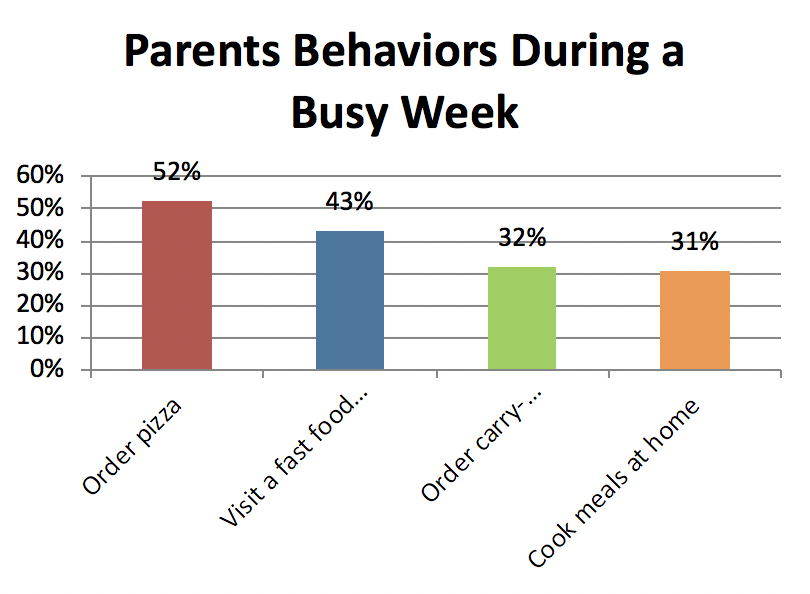
Source: Valassis Awareness-to-Activation Study conducted by NPD. Question: Whenever you have a busy week with a lot of activities/sports scheduled for your child(ren), which of the following are you most likely to do? (Please select all that apply)
We know that being a busy parent increases QSR and pizza usage but how do companies fighting for share of stomach capitalize on these trends? And on a larger scale, how are industries pivoting to capitalize on the profound shift in the way they can gain and apply advanced consumer attributes?
John Ross, author of two books on consumer behavior and President and CEO of IGA, a 5,000+ store global grocery chain has tackled this issue. He acknowledges that retailers can get confused by consumer data and that consumers that just made a purchase are no longer in the market to buy and therefore shouldn’t be considered shoppers. “Shoppers are people about to buy, and they are much trickier to find. It is especially true with convenience-driven shoppers who may show up, shop and exit at such speed that it’s hard to understand how they shop and why they buy. Spontaneous shoppers often appear to be random and undisclosed, but that is usually not the case. Just because they make quick decisions and move from shopper to customer at speed doesn’t mean they aren’t thoughtful, discriminating and information hungry,” he says. “People in motion need answers fast and they consume media quickly to get the information they need to make smart decisions. They are often highly influenced by user reviews, in-store signage and recommendations. And they tend to over index on mobile usage too.”
I agree with Ross’ assessment that although shopping behavior can appear to be random, it can also be predictive. Capitalizing on four-dimensional data that includes data from past purchases and in-market signals can be used to identify a consumer’s most current purchase intent.
Understanding the consumer is a difficult task especially as consumer behaviors continue to evolve. Technology has finally advanced to capture data that just recently marketers could only dream of obtaining. Developing and targeting personas by looking at consumers in isolation over a short period of time has transitioned to include seasonal and personal modifications. It is now possible to identify prospects that not only look like your consumers, but also travel to or live in your restaurant’s trade area and regularly visit your competitors.
Layering mobile location data with shopping behaviors like purchases, content consumption, promotional/ coupon sensitivity and restaurant visits is the most sophisticated way to ensure you’re not missing key peaks in behavior that may otherwise be overlooked.
The Elusive Heavy QSR User Everyone is Missing posted first on happyhourspecialsyum.blogspot.com
How to Win Every Customer’s Heart
Every service industry wrestles with one problem that is central to everything else we do. We pay a lot of advertising money to draw people ...

-
Every service industry wrestles with one problem that is central to everything else we do. We pay a lot of advertising money to draw people ...
-
As an restaurant manager, you need a resume that shows off exactly what skills you have that make you valuable. Your resume is the first thi...
-
McDonald’s recent acquisition of decisioning engine Dynamic Yield for $300 million is a clear indication of the vital importance of personal...


