Friday, 8 June 2018

Pricing It Right on Your Restaurant Menu

The right price is the one that guests are willing to pay, ensuring maximum profit for the restaurant. It doesn’t matter how many restaurant management and menu engineering books you read, you will never find clear rules for setting the prices of menu items. Experts advise taking how much you spend on purchasing produce and multiplying this amount by three. However, the best teacher is experience. Despite the fact that there is no precise formula for fixing the right prices, I’ll try to shed light on this question and help you figure out how to price your menu.

Before Setting Prices

The Golden Rule of the restaurant business teaches us that menu creation always comes first. Don’t make any decisions on equipment and interior design until the restaurant menu is ready. At the very least, decide on the cuisine and the concept of your venue.

The process of calculating prices lies somewhere between a science, an art and intuition.

Many factors influence how menu prices should be set. I suggest you take note of them before fixing new prices or updating existing ones.

Unstable food prices: Ingredient prices may rise when you least expect them to. You could be prudent, setting higher prices for products which may go up in price. Thus, you won’t suffer losses, even if you spend a little more on these products.

Restaurant concept: Menu prices in a luxury restaurant will obviously differ from prices in restaurants with a lower level of service. Ensure your prices meet the quality of service you provide to customers. For example, there is no way a fine dining menu would include fast food items. And fresh, delicious food is not the only thing a good restaurant has to offer; there are also the interior design, pleasant atmosphere, and quality service. All of this directly affects how the menu should be priced.

Determine the price range: Every restaurant is individual, and its menu prices depend on location, labor costs, food supply, and demand. First of all, decide on the minimum price that you can offer your customers while achieving the desired profits. Then set the maximum price which customers would be willing to pay for your services. Gather information about the demographics of your state and average salaries.

Raise menu prices discreetly: Small price increases will be less noticed by customers and will simultaneously bring you substantial profits. In addition, prices ending in odd numbers, for example, $5.35 or $5.95, are also less noticed by customers than whole numbers.

How to Price Menu Items

The process of calculating prices lies somewhere between a science, an art, and intuition. Unfortunately, such an important part of a restaurant’s marketing plan has no accurate and reliable way of being calculated. In the end, when you get right down to it, you are faced with the questions of how this is done and where to start. To figure this out, I recommend following these five steps.

Step One:Determine the cost price of each menu item. Take into account all the expenses on food, beverages, waste (from boiling, frying, baking, etc.) and other direct and indirect costs. Most novice restaurateurs avoid these calculations, leading to inconsistencies in their budgets. Be smart in running your business rather than fall into this trap: Remember, those who know all the numbers will never make fatal mistakes. A responsible business owner will keep all documentation and reports in order and have the expenses and income of his restaurant under control. And the days are over when accountants and managers buried themselves in tons of paperwork. Now it’s possible to store your information in the cloud and use a reliable POS system for your accounts. Most point of sale software calculates the cost not only of the ingredients individually but the dishes in general. So, if you want to make your life a lot easier, then do your research and choose a system which works best for your business.

Step Two: When you figure out the cost of the ingredients and dishes, it’s time to move on to the next stage—the extra charge. Multiply the cost of each menu item by a factor from 3 to 7. Depending on your restaurant type and target audience, choose a ratio appropriate to your business. Taking into account all the costs arising (public service, taxes, rent, marketing, unexpected price increases, etc.), it will be impossible to achieve the desired profit at a low margin.

If you’re still not sure whether you need to increase the prices of existing menu items, and if the chosen pricing policy is appropriate to your target audience, you need to view this from a different perspective. To keep prices stable, you could find ways to reduce costs (for example, make purchases and production more economical), change a few expensive ingredients in certain dishes to cheaper substitutes, or try to slightly reduce the size of portions.

Step Three: Compare your prices to your competitors. It is also important to consider what overheads they have and, again, compare expenses. For example, if restaurant X has its own real estate and doesn’t pay rent, this is definitely an advantage. This may be the reason why X offers lower prices to its customers.

After comparing the prices on the menu, pay attention to the attractiveness and quality of the dishes. Even if you are sure that your restaurant is more attractive to potential guests, avoid the temptation to increase prices by too much, unless you have a specific and unique dish that attracts people.

If you set unreasonably high prices, guests will be disappointed. Don’t make it happen! If guests feel cheated, they will never come back to you, and moreover, they will share their doubts with other people. This can lead to the loss of regular guests and the reputation of the restaurant.

Step Four: Have you ever heard of menu engineering? This method helps you find the weak spots on your menu and improve them. Conduct a technical analysis of the menu not later than a month after the restaurant opens, and then repeat it monthly or quarterly. This is a very important part of restaurant management and deserves special attention. If you don’t know how well each menu item works and how much money it brings in, it will be hard to achieve the hoped-for constant profit.

Step Five: This step will help your menu work even better after you have set the prices. Highlight your most profitable dishes. Many dishes just take up space on your menu without bringing in much profit. Do everything possible to draw the attention of customers to the most cost-effective meals on your menu.

Menu development requires a lot of effort but if you do everything properly, the benefits will just be a matter of time.


Pricing It Right on Your Restaurant Menu posted first on happyhourspecialsyum.blogspot.com

Thursday, 7 June 2018

Eating Trends by Region – How Do They Differ?

Sixty-six percent of UK adults describe themselves as being passionate about food and drink. With Britain being a nation of foodies, It comes as no surprise  that 50 percent say they are passionate about home cooking, with 53 percent of millennials eating out at least once a week. Millennials are the most common demographic to go out for food as oppose to those of an older demographic.

Whether it is takeaways, restaurants or luxury food from the supermarkets, it comes as no surprise that Brits spend a small fortune on food. It Is reported that the average Brit spends around £44 per week on restaurant bills alone. But what does our money get spent on? Designers of bespoke kitchens in Sussex, Harvey Jones, takes a look at the UK’s eating habits by region.

Eating Out

The average Brit can spend around £288,000 in their lifetime eating out at restaurants, the Sun reports.

One of the favourite options amongst those who commonly eat out is traditional British ‘pub grub’ with the majority of people owning up to the fact that they eat out at least once a week. 18-29 year olds spend double the amount of other demographics on eating out – with an average spend of £88 per week!

The most Indian, Chinese, Thai, fish and chips and pizza meals at restaurants are found in London are more common than any other city in the UK. The South East and Northern Ireland aren’t far behind the big city though, whilst Scotland appears to be the region that eats out the least.

The Curry Capital is known as Birmingham with 43 percent of residents claiming curry restaurants are their favourite, which 34 percent of Londoners seem to agree with. Spanish tapas (14 percent) is preferred in Glasgow while 14 percent of Edinburgh folk love Sushi.

Pub grub is one of the most popular choices in the UK – and Liverpudlians couldn’t agree more; 49 percent would choose traditional pub food. A strong favourite of those all over the UK.

Takeaway Lovers

The average Brit spends around £9.75 on eating out or takeaways for themselves at least once a month according to Payment Survey. Annually, this works out at £117 per person.

The Takeaway Capital of the UK with a reported 279 takeaway restaurants is known as Bristol, however Leeds appears to be the greatest lover of the takeaways. 77 percent of Leeds folk admit to having at least one takeaway a month.

Less than 25 miles away, people in York don’t dine as regularly on takeaways, with only 25 percent of them ordering a monthly take out.

The favourite cuisine across the whole of the UK tends to have been Chinese. Only 3 out of the 30 cities questioned didn’t crown Chinese as their favourite takeaway – and of all individual respondents asked, 35 percent voted Chinese as their favourite. This trend is mirrored between male and female respondents, too.

In second place, Indian cuisine follows as a close second place, with 24 percent of the votes. Indian stole the crown as the number one favourite takeaway in Aberystwyth, Coventry and Wolverhampton.

Home Cooking

In 2017, just over 20 percent of British families said they sat down to dinner together once or twice a week, and one in five have their ‘family meals’ whilst sitting in front of the television. Dinner time at home has become far less formal and structured than in previous decades, due to busy work schedules and family life. However, some people prefer to cook their own meals at home, as they can control their own ingredients (49 percent). This also helps with those who are trying to monitor their diet – a healthy alternative to a takeaway. This is also a cost effective approach as oppose to spending a large sum on takeaways and meals out each week.

Statista reported that 64 percent of people enjoy cooking, while 55 percent describe cooking as something they have to do but don’t. There has also been a 10 percent increase in the number of people preparing meals from scratch at least once a week from 2005.

But which regions are most likely to cook homecooked meals? Scotland, Wales, the North West and North East were the regions that appeared to eat out the least, leading us to the assumption that they are more likely to stay home and prepare home-cooked meals more often. Judging by how much London, the South West and Northern Ireland eat out, we can assume that they are the regions that are least likely to stay home and cook meals.

Now that open-plan living is on the rise, cooking a meal doesn’t have to be a lonely task; you can prepare a family meal in your modern kitchen while spending time with the family. Or entertaining friends. The kitchen is no longer just a place to dine, but also a place to socialise and make the most of the space that’s on offer.

Sources

https://trajectorypartnership.com/wp-content/uploads/2015/07/SaclaReport_v19FINAL.pdf

http://www.independent.co.uk/life-style/food-and-drink/deliveroo-takeaway-food-most-popular-a7573141.html

http://www.mirror.co.uk/news/uk-news/takeaway-capital-uk-fast-food-6372818

http://www.independent.co.uk/news/business/news/takeaway-just-eat-sales-up-rise-increase-home-delivery-appetite-local-restaurants-a7713366.html

https://www.paymentsense.co.uk/blog/what-is-the-uks-favourite-cuisine/

https://www.thesun.co.uk/news/2893113/brits-spend-more-than-288000-eating-out-at-restaurants-in-their-lifetimes-because-were-too-lazy-to-cook/

http://store.mintel.com/attitudes-towards-cooking-in-the-home-uk-may-2016

https://www.statista.com/statistics/301495/attitudes-to-cooking-eating-meals-uk-great-britain/

https://www.bbcgoodfood.com/article/bbc-good-food-nation-survey-results

http://www.chroniclelive.co.uk/news/health/data-regions-uk-eat-most-6404531


Eating Trends by Region – How Do They Differ? posted first on happyhourspecialsyum.blogspot.com

Tuesday, 5 June 2018

Restaurant Marketing Trends: How to Attract More Diners

Diners today are demanding innovation in ways that drive industry trends, restaurant marketing strategies, and entire operations. For restaurateurs and foodservice executives, this means keeping customers’ needs at the forefront, even well before they set foot in your location or make a call for a reservation.

Eager to supercharge your marketing performance and attract more diners to your restaurant? Here’s a list of industry trends, plus actionable tips and tactics, to help you get started:

Build and Optimize your Presence on Google

If online reviews can make or break a restaurant, you might be wondering: where exactly can these reviews be found?

According to the 2018 online reviews survey by ReviewTrackers, Google is the platform that’s dominating the review market.

  • 64 percent of consumers say they are likely to check reviews on Google before visiting a business — more than any other review site.
  • 21 percent agree that Google reviews are one of the most important factors in their search for a local business, ranking them as more influential than pricing information, proximity, and search engine results pages (SERPs).
  • Google has also become the No. 1 site for online reviews (followed by social media platform Facebook), reinforcing the trend where sites that focus primarily on reviews (like Yelp and TripAdvisor) are seeing less growth than sites where consumers are likely to already have user accounts (and therefore experience less friction in leaving reviews of businesses).

Here are a few more interesting highlights from the survey:

  • Reviews are getting shorter. Your customers are writing simpler and more to-the-point reviews. The average review has gotten 65 percent shorter since 2010 and is now roughly the size of a tweet.
  • Customers expect businesses to respond ASAP. 53.3 percent of customers expect businesses to respond to their online review within 7 days. This marks an increase from 51.7 percent in 2017. Moreover, 45 percent of consumers say they’re more likely to visit a business if it responds to negative reviews.
  • Diners are writing increasingly positive reviews.Reviews are shifting from being a place where consumers rant to a place where they are recommending restaurants after a positive experience.

One key takeaway: make sure you claim and manage your business listing on Google via Google My Business, if you aren’t already doing so.

Add your NAP (Name, Address, and Phone), upload high-quality photos of your interiors and menu items, respond to your online reviews, ensure that your location is displayed correctly on Google Maps, and write out your Google business description.

Share Lots of Photos and Videos

You probably already created profiles or pages of your restaurant on multiple social media platforms like Facebook, Instagram, and Twitter. If you haven’t already done so, be sure to develop a plan around regularly sharing high-quality photos and videos: visual content for driving engagement with hungry diners.

Here are some great ideas on what to upload:

  • Mouth-watering shots of your menu items
  • Photos of your restaurant location’s interiors, facilities, and kitchen
  • Photos of your chef and kitchen and wait staff
  • A live Q&A interview with your chef of mixologist
  • Video tour of your restaurant
  • A behind-the-scenes video of what goes on in the kitchen
  • Live video streams of parties, fundraisers, special occasion events

Photos and videos allow your customers to feel more connected to and engaged with your restaurant, before and after their actual dining experience.

Share Your Menu on Social Media

Seven in eight consumers routinely turn to technology to discover dining destinations, and 86 percent regularly check out menus online before they eat out.

This means you shouldn’t let your menu sit idly on your website. Make sure you also share it on social media as well as other digital properties where your restaurant has a presence. Include a link to it in your emails, tweets, and Facebook posts, so that potential customers can take action, browse for more information, and engage. Sharing your menu on social media is a great addition to your restaurant marketing toolkit, especially if you offer delivery.

Manage Your Restaurant’s Online Reviews

At a time when diners can quickly become food critics, you must be able to monitor and respond to online reviews of your restaurant across multiple sites and platforms.

Facebook, Google, Yelp, and TripAdvisor are some of the top review sites that diners use, but pay attention as well to restaurant-specific review sites and booking platforms like OpenTable, Eat24, Grubhub, and Zomato.

  • According to Weber Shandwick, 77 percent of consumers pay more attention to reviews written by their peers than to professional critic reviews.
  • 33 percent of restaurant-goers will not choose to eatat a restaurant with an average rating of less than 4 stars out of 5.
  • According to OpenTable, 60 percent read reviews before going out for a meal, a habit that takes precedence over getting directions to a restaurant or looking at food photos.

Responding to reviews, listening to the voice of the customer, and resolving their issues will go a long way in helping you protect your restaurant’s online reputation; more importantly, review management will provide you with the insights that you need to consistently deliver great dining experiences.

Restaurateurs who keep their fingers on the pulse of evolving diner demands and expectations are the ones most poised to succeed. This means that managing reviews and customer feedback is critical and can spell the difference between experiences that delight and experiences that don’t.

Create or Join Conversations Around Food-Related Holidays

Most restaurants will have marketing campaigns for traditional holidays like the Fourth of July or the Super Bowl. If you’re looking to further distinguish your restaurant from your competition, cook up something special — on social media or in-store — for foodie holidays, too, particularly if it’s relevant to your menu offering.

It could be Chinese Almond Cookie Day, National Seafood Bisque Month, or National Spanish Paella Day. Whatever the occasion is, find a way to tie it into your menu in order to continually boost your restaurant’s visibility.

Invest in Data and Tech

According to Franchise Help:

  • 75 percent of consumers will at least view menus on their smartphone before trying a new restaurant.
  • Approximately 40 percent will pay with their phone when they can.
  • About one in three are receptive to SMS marketing.

Your restaurant’s highest marketing investment priorities should include customer-facing technology offerings like digital menus, online ordering, and digital loyalty programs. Forget business cards in a fishbowl. To truly understand diners and customers and inspire loyalty, you must make technology an investment priority — and develop the capability to collect actionable data and manage high-impact trends and issues affecting the guest experience.


Restaurant Marketing Trends: How to Attract More Diners posted first on happyhourspecialsyum.blogspot.com

Monday, 4 June 2018

How Does Your Restaurant Stack Up to These Industry Standards?

Are you sizzling or fizzling?

The restaurant business has never been for the faint of heart (or stomach), but in this era of Twitter, Uber, and every “Uber for _____” app under the sun, it’s enough to make even veteran restaurateurs’ stomachs churn–and not from the Romaine lettuce!

But one advantage of running a restaurant in the smartphone era is the ease in which you can obtain boiling pots of tasty data that can tell you if you’re doing something right and wrong, and what that “something” is.

One of the most important data points to track is your Average Order Value (AOV), which is the average total bill for your customers. A higher AOV means diners are ordering more items in one sitting, and every restaurateur worth their (literal) salt knows that it’s loads more cost-effective — and therefore, more profitable — to get your existing customers to order more than it is to get new customers to order anything at all.

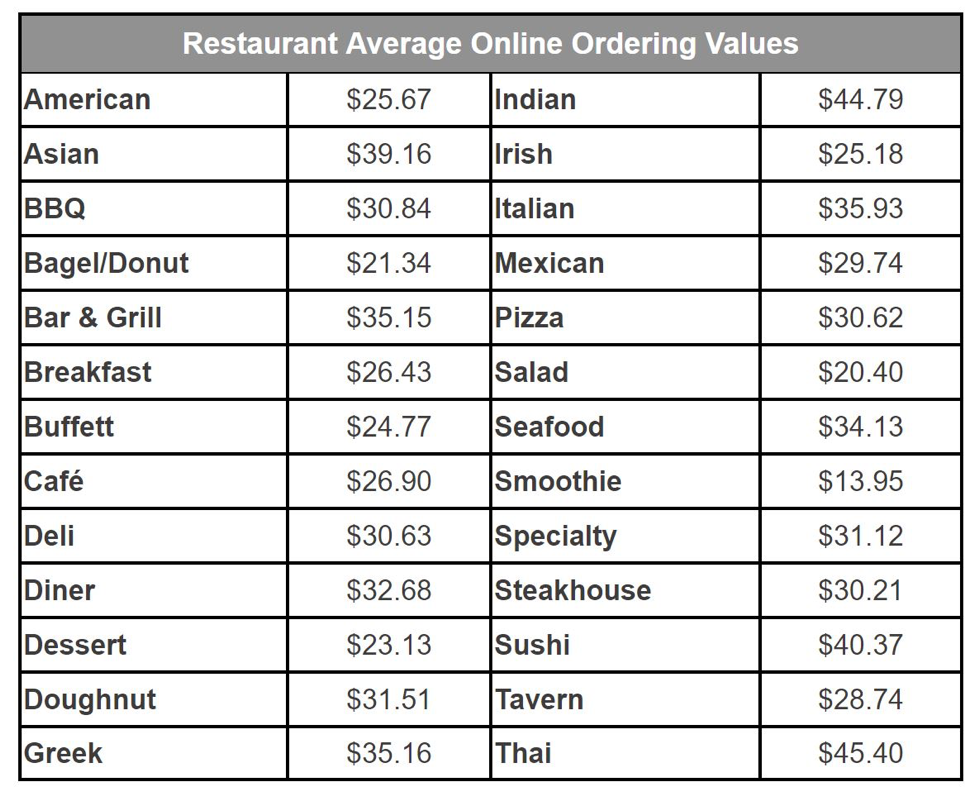
Another advantage of all this access to data? It’s much easier to compare how you’re doing, relative to your competitors. And because my company’s online ordering platform collects all this data, we have been able to set AOV benchmarks — both for individual food types, and for the restaurant sector as a whole, savory pie.

Behold!

The 2018 Online Ordering Benchmarks

Taken together, this averages out to an AOV of $32.73 across all categories.

But what does this all mean? What do these numbers tell us?

Several things, which may or may not be relevant to you, depending on your restaurant. Here are a few things that jumped out at us:

People Can’t Get Enough Asian Food

And not just “Asian” as an umbrella category; even broken down by region, Asian restaurants — think Thai, Indian, and Japanese — all commanded the highest AOV, from $40.37 for Sushi to $45.40 for Pad Thai.

People Aren’t Eating Their Veggies

Some things never change from childhood; men and boys will always love their toys, girls and women will always get the last word in, and adults and children alike will never eat enough greens.

The benchmark AOV for salads is just $20.40, while smoothies — another concoction designed to make plants more palatable — average out to a paltry $13.95. So while our food options have dramatically expanded since the caveman era, our food preferencesseem to have dragged their feet a bit.

But They ARE Eating Carbs

Doughnuts pulled in an AOV of $31.51, which is an insane amount to spend on just doughnuts (Homer Simpson would be proud). Pizza, that essential Friday night staple, came in close behind at $30.62. Bagels, another tried and true carb bonanza, came in at $21.34. Not too shabby!

How to Blow Past the Benchmark

If you’ve looked at these benchmarks with a combination of envy, terror, and shame, you can then proceed in one of two ways:

  1. Rationalize your lower-than-average AOV by invoking skewed averages, different markets, or any other conceivable reason your restaurant isn’t really behind the curve, in spite of the evidence in front of your eyes, or…
  2. Find ways to increase your AOV to at least meet, if not surpass, the AOV for your category.

Fortunately, there is one fix that’s proven to significantly increase your AOV: offer your customers online ordering.

I mean, doesn’t it make sense?

Combine people’s propensity to both overspend on the Internet and overeat when they’re hungry, and of course they’re going to buy more food when ordering online. Add a dash of instant gratification, and it’s easy to see why online ordering has become so ubiquitous it’s become almost required in the industry.

And the numbers bear it out — restaurants that use online ordering almost universally find that their online order values increase compared to offline orders. This is true regardless of restaurant category or cuisine.

In fact, Domino’s — which practically invented restaurant delivery as we currently know it — has seen 24 straight quarters of constant sales growth in the United States. And online ordering has been key to that growth.

Don’t take my word for it; none other than Domino’s CEO Patrick Doyle has said that “technology has clearly been a big part of what’s been driving the business over the last five years.”

Now, I know what you’re thinking. “But Roddy,” you type in the comment box, “I’m not Domino’s, I’m a neighborhood artisanal baker. I don’t have hundreds of thousands of dollars to blow on building a new online ordering system.”

I hear you. In this business, who can even think about creating such a system from scratch? But here’s the sweetener in the latte: you don’t have to. There are apps that can do it for you.

Take Total Loyalty Solutions, which you can read all about by clicking here, for example. Don’t worry, I’m not doing the hard sell here. But I will say that our clients who upgraded to our new online ordering platform saw their online AOVs increase to $37.96 just this past March.

That’s more than the global average of $32.73, by the way. Just sayin’.

However you choose to go about doing so, just make sure you offer your customers the chance to order online, directly from you,through an in-house online ordering system. (and use caution when working with GrubHub, Seamless, and all those other online food aggregators out there — trust us on this one.

OK, My Customers Can Order Online. Now What?

If you already offer online ordering and your AOV is still not what you want it to be, fret not — there are plenty of neat tips and tricks to help you increase your online ordering values:

Promote Add-Ons at Checkout: This one’s easy: highlight premium items, or promote add-ons (sides, drinks, and desserts, for example) while your customers are checking out. You can use either pop-ups, or display them prominently on the checkout page itself.

Offer Online-Only Deals: Do you offer specials to your sit-in customers? How about your online customers? Offering online-exclusive specials is an easy way to encourage customers to order online. Combine this with some of the other tips on this list, and your AOV will soar in no time!

Give Discounts for Direct Online Orders: If you found out the nasty truth about food aggregators the hard way and are stuck paying high commissions to aggregate platforms like Grubhub for each order, don’t worry. You can fight back! By giving discounts to customers who order directly from your online ordering system, instead of through the aggregators, you’ll slowly but surely get your customers back.

Sell Bundles of Food: Fast food companies are insanely good at selling bundled meals — think McDonald’s Extra Value Meals, or Wendy’s 4 for $4 Meal — but that doesn’t mean you can’t have a bite of that burger! Bundle up and sell two or more items together, even if it’s just a sandwich and a drink —for a slight discount (much like you’d do a lunch special). Then watch it become one of your most popular offerings… especially if you sell it at a nice, round price point ($5 footlongs, anyone?).

Create Your Own: There are as many ways to mix and match items in a bundle as there are ways to mix ingredients in a meal. Bundle some of your customers’ favorites (or bundle a new dish with an old one, or bundle something else entirely), only offer it with direct online orders, and highlight additional items to add during checkout.

Then, by the time next year’s benchmarks are released, you’ll be much happier with where your AOV is. Bon appetit!


How Does Your Restaurant Stack Up to These Industry Standards? posted first on happyhourspecialsyum.blogspot.com
Friday, 1 June 2018

The Roller Coaster Ride Surrounding the Tip Credit

Restaurant patrons customarily tip, which is why restaurants often pay tip-eligible employees less than the federally mandated minimum hourly wage, currently $7.25.

How tips are handled is one of the more complex areas of restaurant compliance, and restaurants face unique challenges as a result. Restaurants are required by law to pay taxes on tips employees receive because they are defined as income under the Federal Insurance Contributions Act (FICA). The Fair Labor Standards Act (FLSA), however, allows restaurants to take a “tip credit,” which is what allows them to pay eligible less than the federally mandated minimum. With the tip credit, an employer can pay tipped employees less than $7.25 and use the tips to cover the difference.

A clear understanding of the rules surrounding the tip credit is crucial for restaurant employers because the consequences of violating them are dire. Restaurants that do not follow the tip credit rules lose the tip credit and must pay the affected employees minimum wage.

How the Tip Credit Works

To take the credit lawfully, restaurants must follow very specific rules. In general, a “tipped employee” is any employee engaged in an occupation in which he customarily and regularly receives more than $30 a month in tips. If the employee performs “dual jobs”, that is one which is a traditionally tipped position and another which is not, the employer may only take a tip credit for the hours the employee works in the tipped position. Also important, is the requirement that employee provide a tipped employee with notice of the tip credit before an employer takes a tip credit. That notice must include information regarding: 1) the amount of the cash wage paid; and 2) the amount of the tip credit taken by the employer. In addition, the notice must inform the employee that all tips received must be retained by the employee except where there is a valid tip pool.

Note: An employer should never require employees who are customarily and regularly tipped to share tips with management or supervisors.

When Employers Opt Out of the Tip Credit

The rules were well defined until some employers with tipped employees decided not to take the tip credit. In other words, they were paying their tipped employees $7.25 or more an hour. Those employers took the position that the FLSA did not control the tips as long as they were paying employees at least minimum wage. Thus, the employer could require tipped employees to share tips with those employees who are not regularly tipped or even keep the tips themselves. In 2011, however, the Department of Labor under the Obama administration issued a regulation that prevented employers from touching the tips, whether or not the employer took the tip credit. The DOL took the position that the employer could never take or make the employee share the tips. The issue of whether the FLSA controlled tips where the employer did not take a tip credit went through the court system, and there was a split of authority as to whether the Department of Labor actually had any authority over the tips where the employer did not take the tip credit.

The Ongoing Evolution of Tips

As this issue was winding its way through the court system, the Trump administration’s DOL rescinded the 2011 regulation and said that if the employer were not taking the tip credit, the DOL had no control over the tips, and the employer was, therefore, free to do whatever it wanted with them. Then, on March 23, 2018 in a surprise move, the Fair Labor Standards Act (FLSA) was amended through President Trump’s spending bill. Trump signed the Consolidated Appropriations Act, which includes a clause that amends the part of the FLSA that deals with tips. The amendment to the statute provides that the employer may not keep tips received by employees for any purpose regardless of whether the employer takes the tip credit. Now, whether or not the employer takes the tip credit, the tips belong to the employees.

Here’s the change: If the employer pays minimum wage or more, it can have the employee share the tips with non-tipped employees, such as dishwashers and cooks. This change really helps bridge the gap in the pay between front- and back-of-the-house employees.

To be clear, in the situations where the employer does not take the tip credit, it still cannot assert any control over the tips; but the amendment expands the type of positions with which the employer can require the tipped employee to share those tips. And because this was done by amending the FLSA, it is now the law, regardless of the DOL’s position.

Of course, there will still be litigation regarding who is in the tip pool where the employer does take the tip credit. Some things never change.


The Roller Coaster Ride Surrounding the Tip Credit posted first on happyhourspecialsyum.blogspot.com
How Restaurants Can Benefit from IoT-Enabled Energy Management

For a restaurant company, the cost of heating and cooling buildings and powering kitchen equipment represents three to five percent of total operating expenditure. In a competitive industry with razor-thin margins, even a slight improvement in efficiency can make a significant difference, especially for large operators overseeing hundreds and thousands of facilities. The trouble is, restaurant managers have traditionally struggled to gain insight into energy usage. They know that aging freezers, ovens and fryers might break down at any time, but they can’t anticipate when to do a maintenance check. Similarly, they know that they spend more than necessary on heating and air conditioning, but they can’t identify and address specific sources of waste.

In a competitive industry with razor-thin margins, even a slight improvement in efficiency can make a significant difference.

That is changing, as restaurants apply Internet of Things (IoT) and smart building capabilities to dramatically enhance their ability to manage energy consumption and reduce costs. An Energy Management Solution (EMS) utilizes intelligent assets to collect, analyze and share data on how a restaurant consumes gas, electricity, oil and water. Based on this information, managers can more easily implement measures to be smarter about resource utilization. An EMS can, for example, detect cold air leaking from a freezer door, or send an alert when a condenser coil needs cleaning or an AC filter needs changing. Or, by gauging consumption against thermostat settings, an EMS can calculate the optimal temperatures needed over a 24-hour period to keep spaces heated in winter and cooled in summer.

While enhancing – and largely automating – these basic energy management practices, an EMS can also serve as a foundational element or building block of a broader IoT strategy that leverages data collection and analysis to optimize kitchen practices and enhance the customer experience. By establishing networks of smart, connected devices, the IoT can create a momentum-building virtuous circle of continual improvement, feedback and refinement. Through this process, businesses are able to glean increasingly insightful and actionable knowledge across the business.

For a restaurant, basic IoT opportunities include smart sensors on fryers that maintain an optimal oil temperature and help cooks determine when French fries are perfectly done, as well as aid compliance with safety and hygiene standards by alerting managers when oil should be filtered or changed.  Refrigerator sensors can monitor perishables and notify kitchen staff when ingredients are nearing expiration and when new orders should be placed.

Digging deeper, the data collected by a smart fridge can complement Point of Sale (POS) data on incoming orders to drive analytics on demand and supply in real time, allowing kitchen staff to retrieve precise amounts of specific supplies, thereby minimizing energy loss from thermal transfer. And combined with historical data, smart sensors can enable predictive analytics – helping, say, a sports bar predict how many avocadoes will be needed for guacamole orders for Super Bowl Sunday.

Smart, connected sensors – coupled with increasingly sophisticated POS and guest data – can also take customer engagement to a new level. Strategically placed beacons and WiFi networks can monitor foot traffic near a restaurant, and automatically trigger the sending of tailored promotions and incentives to loyal customers to encourage them to go in. These insights can also help restaurants minimize waste by promoting surplus items – such as offering frequent guests free guacamole or wings samplers on the Monday after the Super Bowl.


When selecting an EMS strategy, interconnectivity is essential. While that would seem obvious, any solution – whether focused on energy savings or a broader IoT scope – has to accommodate a wide range of standards and protocols. As such, due diligence should focus on the ability to integrate multiple devices with a minimal amount of complexity, customization or third-party intervention. Another priority should be an agnostic approach that doesn’t require lock-in with a particular platform or solution.

In terms of defining a roll-out strategy and building a business case, an initial focus on energy savings and concrete results, followed by a more ambitious foray into IoT capabilities, can be effective. Given the expansiveness of the technology, businesses of all kinds have struggled to get their arms around the IoT in terms of charting a roadmap or identifying quantifiable objectives.

Creating a plan around something as straightforward as energy savings can make the IoT “real,” and allow success to be measured in terms of incremental steps rather than by a risky leap of faith towards a vaguely defined future vision.


How Restaurants Can Benefit from IoT-Enabled Energy Management posted first on happyhourspecialsyum.blogspot.com

How to Win Every Customer’s Heart

Every service industry wrestles with one problem that is central to everything else we do. We pay a lot of advertising money to draw people ...